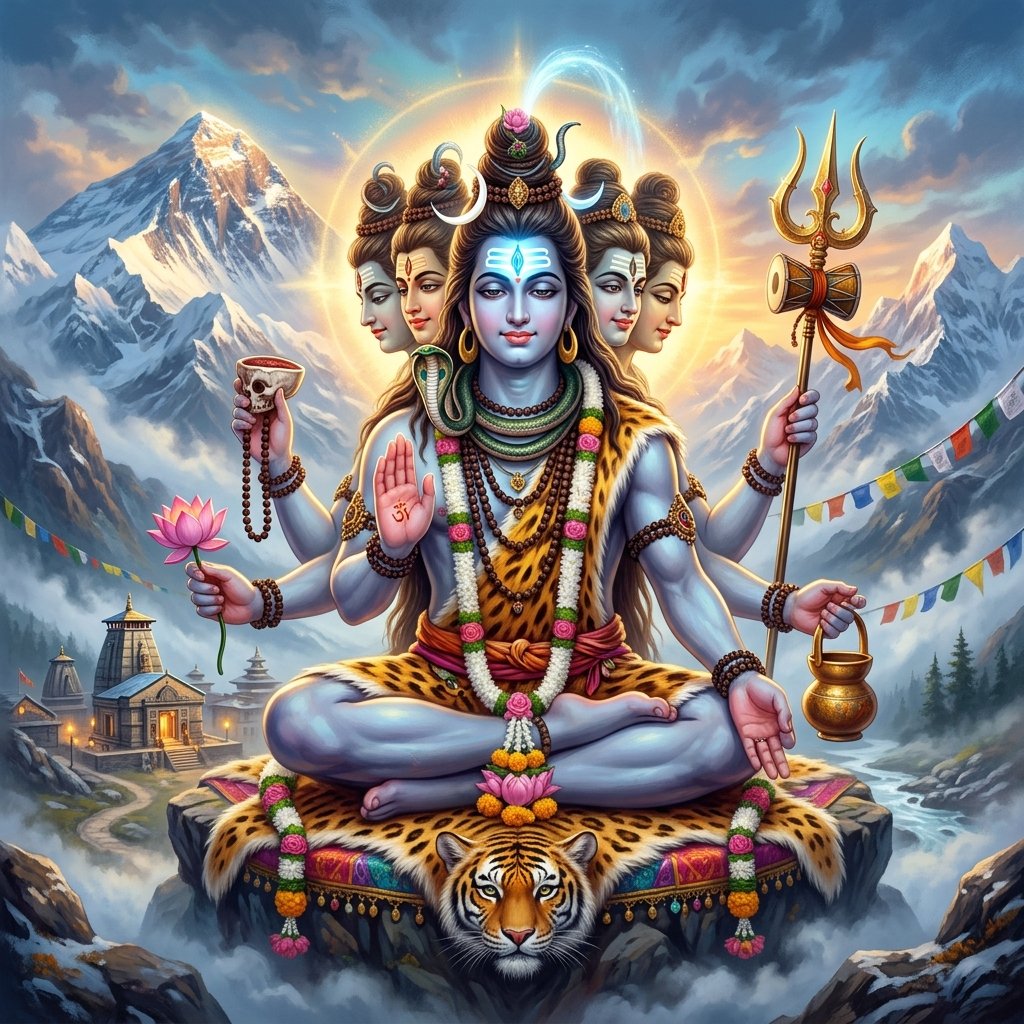
Shri Pashupatinath is a highly revered manifestation of Lord Shiva, honored as the 'Lord of all Living Beings' (Pashu meaning beast or individual soul, and Pati meaning protector/lord). He represents the supreme consciousness that governs the universe, protecting and guiding all life forms. In Vedic philosophy, Shiva as Pashupati is the ultimate cosmic energy that dissolves the bondages of ego and attachments, leading the soul toward Moksha (liberation).
Devotees pray to Pashupatinath for inner stillness, healing of physical and mental illnesses, and the safety and well-being of all living beings on earth. He represents our deep spiritual connection to nature and all animals.
The worship of Shiva as Pashupatinath dates back to antiquity, as described in the Shiva Purana. According to legend, Lord Shiva once fled Kailash and took refuge in the beautiful Shleshmantak forest of Nepal, taking the form of a golden-horned deer to escape his cosmic duties. When the gods discovered him, they attempted to capture him. During this event, Shiva manifested his divine form as Pashupati, the protector and lord of all creatures, declaring that anyone who worships Him here would be freed from taking birth as an animal (Pashu Yoni).
Spiritually, "Pashu" represents the individual soul bound by worldly attachments, ego, and ignorance (Pasha). "Pati" is the supreme lord who controls the cosmic energy. Through sincere devotion and prayers to Pashupatinath, devotees seek to break their worldly bonds (Pasha) and attain spiritual liberation (Moksha). The deities are traditionally depicted with five faces representing the five sacred elements of creation: Sadyojata (Earth), Vamadeva (Water), Aghora (Fire), Tatpurusha (Air), and Ishana (Ether).
Mondays and Pradosham days are marked by special abhishekhams and prayers to Lord Pashupatinath, attracting many devotees seeking Shiva's blessings.
नागेन्द्रहाराय त्रिलोचनाय भस्माङ्गरागाय महेश्वराय ।
नित्याय शुद्धाय दिगम्बराय तस्मै नकाराय नमः शिवाय ॥
मन्दाकिनीसलिलचन्दनचर्चिताय नन्दीश्वरप्रमथनाथमहेश्वराय ।
मन्दारपुष्पबहुपुष्पसुपूजिताय तस्मै मकाराय नमः शिवाय ॥
"Salutations to the auspicious Shiva, who wears the king of snakes as a garland, who has three eyes, whose body is smeared with sacred ash, who is the supreme lord, eternal, pure, and clad in the directions (represented by the letter 'Na')."
"Salutations to the auspicious Shiva, who is worshiped with the waters of the heavenly Ganga and smeared with sandalwood paste, who is the lord of Nandi and the Ganas, and who is adored with Mandara and various other flowers (represented by the letter 'Ma')."
"Pashu" refers to all living creatures or individual souls, while "Pati" refers to the supreme protector or lord (Shiva). Thus, Pashupati Nath is the Lord of all living beings, who governs the cosmos and frees individual souls from the "Pasha" (the bondages of ego, attachment, and worldly illusion).
Yes, devotees can book Rudrabhishek poojas, where the priests perform the ritual bathing of the Shiva Lingam with milk, honey, yogurt, and water on their behalf. Sincere daily offerings of water and Bilva leaves are also welcomed during Darshan hours.
Maha Shivratri is the grandest festival celebrated at the temple, featuring overnight prayers, multiple phases of abhishekams, and devotional songs. Monthly Pradosham days are also observed with special evening rituals and offerings.